| Home | Nature Weekly Index |
26 February 2017 | White Flies | Plant Pest |
White fly is a common plant pest usually found on the underside of the leaves as white powdery substance to the naked eyes. Due to its tiny size, you will have to take a much closer look into these white particles to single out this insect. Their nymphs, being surrounded by the whitish material are even smaller and their eggs are almost invisible. Massive yellowing of leaves may be a sign of their invasion. This was exactly the state of my Sweet Leaf Bush (Sauropus androgynous) in the last few weeks --- majority of the leaves started to turn yellow and some even had dark patches, which were supposed to be the mould that came along due to the substance secreted by the nymphs of the white fly. To eradicate them completel y, I had removed all the Sweet Leaf Bush in my pots yesterday. The lush and healthy Sweet Leaf Bush shared in a post in July 2016 was gone.
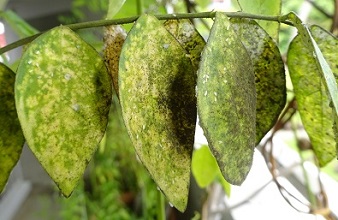
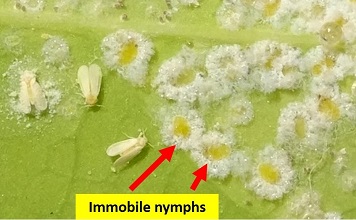
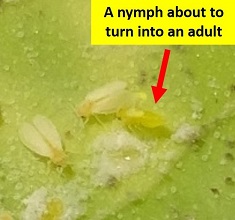
I had white fly on my only pot of Citrus microcarpa (Calamansi) all year round. This Calamansi was attacked from 2 fronts, by these white flies and occasionally by caterpillars of the Lime Butterfly. While the caterpillars consumed the leaves, the white flies sucked the sap from the leaves. I normally kept the caterpillars but would clear the white fly from time to time by simply spraying infested leaf surfaces with water. However, they always returned after some time. Unlike the scale insects, white mealy bugs and aphids, ants did not seem to be interested in tending the white flies and their nymphs.
Though it had a “fly” in its common name, it is not a close relative to the housefly. The white fly is considered a bug under the Order Hemiptera while a housefly is a fly under the Order Diptera. The feeding behaviour of these 2 groups of insect are quite different. White fly has a wide plant host range, indicating that it is not too fussy with its meals.
There is a good reference titled “Tropical Gardeners’ Guide to Healthy Plants” published by NParks in 2010 that provide basic information on plant pests in Singapore.
Update: 11 June 2026
The NParks webpage with information on the book “Tropical Gardeners’ Guide to Healthy Plants” by Pim Sanderson, Fong Yok King, and Daniel Burchamis was no longer available. The book, however, remained listed among the publications on pages 48–49 of the Our City in a Garden Annual Report 2011/2012.
I identified this whitefly as Trialeurodes vaporariorum (Greenhouse Whitefly). According to the Plant Pest Factsheet published by the UK Department for Environment, Food and Rural Affairs, its eggs are typically laid in partial circles and have a greyish colour. Another possible identification is Bemisia tabaci, commonly known as the Silverleaf Whitefly or Sweet Potato Whitefly, which may occur alongside the Greenhouse Whitefly on the same host plant.
In March 2026, I discovered another whitefly species, Aleurocanthus spiniferus (Orange Spiny Whitefly), on the underside of the leaves of my potted plant. This time, the host plant was Piper sarmentosum (Wild Pepper).